Chapter 5
Information technology and the emergence of global communication systems
5.1 Introduction: Electricity as an information carrier
While early electrical engineering focused primarily on energy transmission, a second key application area developed in the 19th century: the transmission of information. Electrical signals were ideally suited for fast, low-loss communication that could be controlled over long distances.
The use of electrical impulses for signal transmission marked the beginning of the technological acceleration of social communication – a crucial step towards globalization.
5.2 The electric telegraph
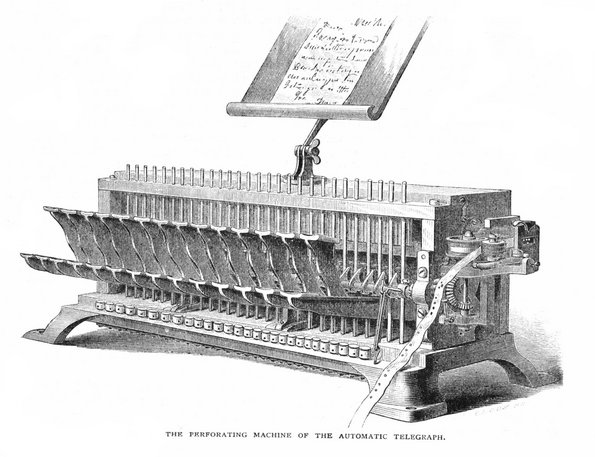
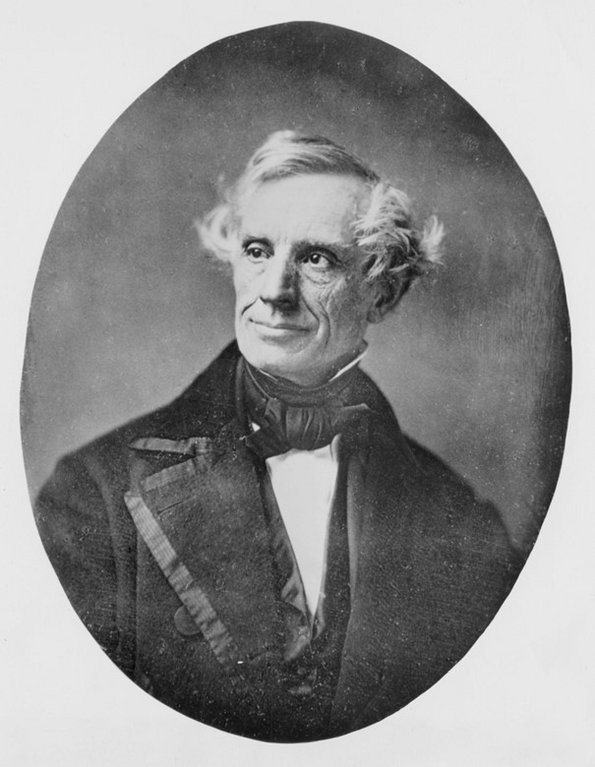
The first practical application was the electric telegraph. Various systems were developed in the 1830s and 1840s, with the Morse system becoming the international standard .
The principle was simple, but revolutionary:
- An electrical current pulse was transmitted via wires.
- At the receiving point, the impulse was made visible mechanically or acoustically.
- A coded sign system (Morse code) transmitted linguistic content.
The telegraph reduced communication times from days or weeks to minutes. The military, railways, and stock exchanges were early beneficiaries of this technology.
5.3 Submarine cables and global networking
The laying of submarine cables made intercontinental communication possible. The first transatlantic cable was installed in 1858, although it initially only functioned for a short time.
Technical challenges included:
- Insulation materials
- Signal amplification
- Susceptibility to malfunctions
- Stress stability
Later improvements led to permanently functional cable systems. This created the first global communications network.
5.4 The telephone: Transmission of analog speech
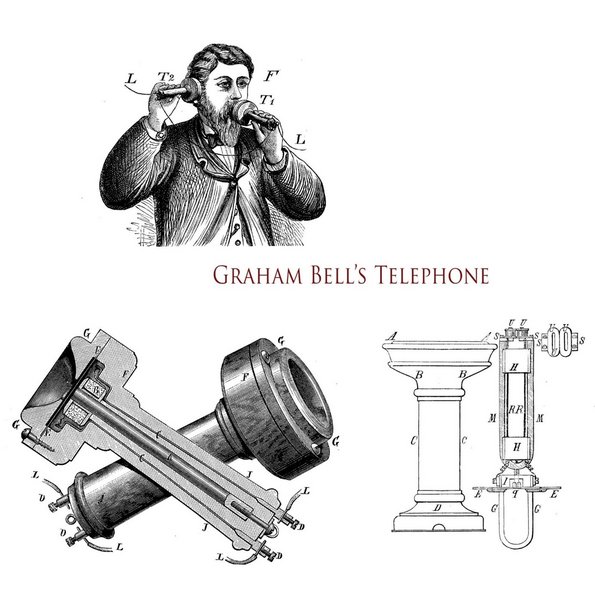
With the invention of the telephone, not only coded information but also direct voice signals were transmitted. The telephone converted sound vibrations into changes in electrical voltage.
Key technical elements included:
- Microphone (sound → electrical signal)
- Piping system
- Loudspeaker (electrical signal → sound)
Telephone networks rapidly evolved into complex switching systems with central control rooms. The integration of automatic switching technology marked the beginning of electromechanical information systems.
5.5 Radio technology and wireless communication
A fundamental advance was the wireless transmission of electromagnetic waves. Building on Maxwell's theoretical work and Hertz's experimental confirmations, radio technology was developed at the end of the 19th century.
Wireless systems enabled:
- Communication with ships
- Military radio communications
- First radio broadcasts
High-frequency technology has developed into a specialized subfield of electrical engineering with its own mathematical and experimental methods.
5.6 Broadcasting and Mass Media
Radio broadcasting originated in the early 20th century. Electrical signals were modulated and transmitted as electromagnetic waves. Receivers could demodulate these signals and convert them back into acoustic signals.
The introduction of amplitude and later frequency modulation improved range and signal quality.
Broadcasting led to the emergence of global mass media and fundamentally changed politics, culture, and society.
5.7 Television and image transmission
Transmitting moving images presented an even greater technical challenge. Electronic image scanning, signal modulation, and cathode ray tube technology finally made television possible.
Key innovations:
- Cathode ray tube
- Line-shifting method
- Synchronization signals
- Color television technology
Television combined image and sound transmission and became a central medium of the 20th century.
5.8 Information Theory and Mathematical Foundations
With the increasing complexity of communication systems, the need arose for a theoretical foundation. Information theory developed mathematical models to describe:
- Signal transmission
- Interference (noise)
- Coding
- Data compression
Terms such as bandwidth, channel, signal-to-noise ratio and entropy became central concepts in communications engineering.
5.9 Digitalization of communication
During the 20th century, the transition from analog to digital signal processing took place. Digital systems offer advantages in terms of:
- Fault immunity
- reproducibility
- compression
- Encryption
The integration of microelectronics and signal processing led to the creation of modern telecommunications networks.
5.10 Global Networks and the Internet
The merging of electrical engineering and computer science led to the development of packet-switched networks. Fiber optic cables, satellite communication, and mobile communications formed the infrastructure for the internet.
Electrical and optoelectronic systems now enable worldwide communication in real time.
5.11 Societal impacts
Communication technology changed:
- Economy (stock exchanges, trade, logistics)
- Politics (rapid dissemination of information)
- Military strategy
- Social interaction
- Media culture
Communication became global, immediate, and digital.
5.12 Summary
Chapter 5 shows that communications engineering forms an independent branch of development within electrical engineering. From the telegraph and telephone to radio technology and the internet, a global information system has emerged.
Key developments:
- Electrical signal transmission
- Wireless communication
- Modulation and coding techniques
- Digitization
- Global networking
Communication technology is therefore one of the most defining technological achievements of the modern world and forms the basis of today's information society.