Chapter 2
Antiquity to the Enlightenment: From observation of nature to experimental physics
2.1 Earliest observations of electrical phenomena
The history of electrical engineering does not begin with technical machines, but with simple observations of nature. As early as ancient Greece, it was observed that rubbed amber attracts light objects such as feathers or dust. This phenomenon was not initially investigated systematically, but remained a curiosity within natural philosophical considerations.
The term "electricity" derives from the Greek word ēlektron (amber). Nevertheless, the phenomenon remained without theoretical classification for centuries. Electrical and magnetic effects were not clearly distinguished and were considered special properties of certain materials.
2.2 Natural Philosophy and Magnetism in the Middle Ages
In the Middle Ages, magnetic phenomena were more of a focus than electrical ones. The compass, probably originating in China and spreading to Europe, played a crucial role in navigation and seafaring. Magnetism was recognized as an independent natural force, but remained interpreted metaphysically.
Only with the scientific revolution of the early modern period did a systematic investigation of electrical and magnetic effects begin.
2.3 The Scientific Revolution: William Gilbert
work De Magnete (1600) marked a decisive turning point. He was the first to clearly distinguish between magnetic and electrical phenomena and conducted systematic experiments.
Gilbert discovered that not only amber, but many other materials exhibit electrical attraction after friction. He coined the term " electricus ," thus laying the terminological foundation for later science.
His work is considered the beginning of empirically oriented electricity research.
2.4 The 17th Century: Instrumentalization of the Experiment
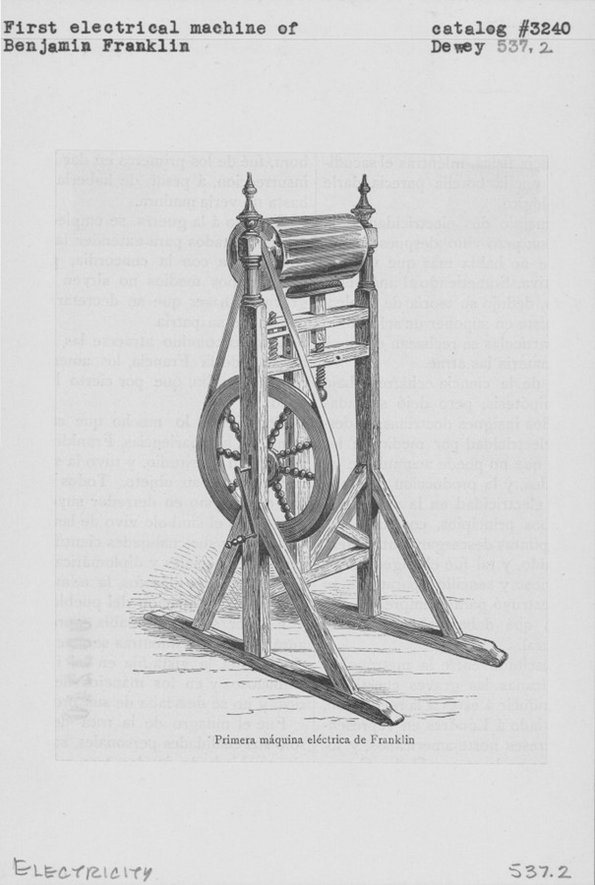
In the 17th century, the first devices for generating electrostatic charge were developed, such as friction machines. These devices enabled reproducible experiments.
Scientists began not only to observe electrical effects, but also to deliberately generate and vary them. This made electricity an experimentally controllable subject of research.
At the same time, initial hypotheses emerged about electrical “fluids”, i.e., invisible substances that were supposed to produce electrical effects.
2.5 The Leyden jar: Storage of electrical energy
A milestone was the invention of the Leyden jar in 1745. It represented the first capacitor and enabled the storage of electrical charge.
This instrument made it possible to generate and systematically study stronger discharges. As a result, electrical research gained considerable momentum.
The Leyden jar was the first to demonstrate that electricity is not just a momentary effect, but can be stored and transmitted.
2.6 Benjamin Franklin and the One-Liquid Theory
In the mid-18th century, Benjamin Franklin developed a theory that electricity consists of a single electrical fluid, the excess or deficiency of which determines the polarity. He introduced the terms "positive" and "negative," which are still used today.
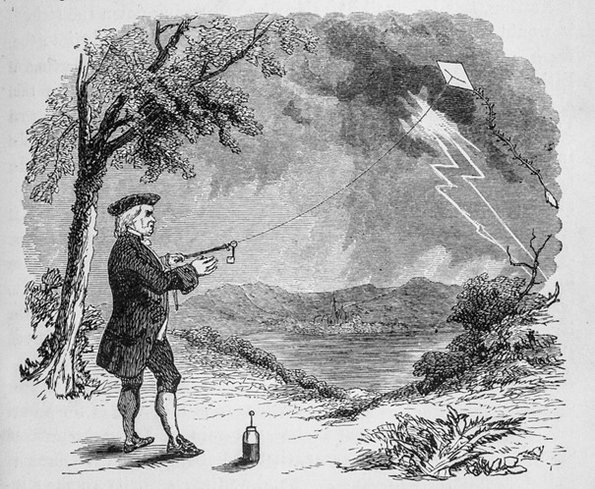
His famous kite experiment (1752) proved the electrical nature of lightning and linked atmospheric phenomena with laboratory investigations.
Franklin's work was not only scientifically but also practically significant: the invention of the lightning rod represented an early technical application of electrical knowledge.
2.7 Transition to quantitative science
Towards the end of the 18th century, the focus shifted from qualitative observations to quantitative measurements. More precise measuring instruments made it possible to determine electrical forces and quantities of charge.
The development of Coulomb's torsion balance allowed for the experimental confirmation of a force law for electric charges. This made it possible to formulate electricity mathematically for the first time.
This transition marks the transformation from a natural philosophical consideration to an exact physical discipline.
2.8 Significance for later electrical engineering
The period from antiquity to the Enlightenment created the fundamental concepts, instruments and ways of thinking on which later electrical engineering could build:
- Experimental Methodology
- Reproducible apparatus
- Early theories of electric charge
- Linking theory and practical application
Without this scientific groundwork, the rapid development of the 19th century – especially electromagnetism, generators and electrical machines – would not have been possible.
2.9 Summary
Chapter 2 shows that electrical engineering has its roots in a long phase of scientific development. From ancient observations through early modern experiments to quantitative measurement science, a theoretical foundation gradually emerged.
This phase was characterized by:
- empirical curiosity
- increasing precision
- instrumental innovation
- theoretical systematization
It paved the way for the scientific and industrial revolution of electricity in the 19th century.